Product Managers
Understand the end-to-end user experience: multi-step identity verification and regulatory data capture.
Start: Journey Overview → Step-by-Step Flow → Design Principles
Welcome to the KYC (Know Your Customer) onboarding specification. If you are new to the firm, this is the single most important system you need to understand. Every customer who wants to buy their first share, place their first F&O order, or simply open a demat account must pass through this gateway. Think of it as the bridge that transforms a stranger on the internet into a verified, regulation-compliant client who is authorized to trade on Indian stock exchanges. By the time you finish reading these docs, you will understand exactly how that transformation happens — from the moment a user enters their mobile number to the moment their signed application reaches NSE, BSE, CDSL, and NSDL.
A complete technical specification for stock broking KYC onboarding — covering the regulatory data collection workflow, identity verification via government sources, batch submissions to KRA/CKYC/exchanges/depositories, maker-checker admin workflow, and full SEBI (Securities and Exchange Board of India) / KRA (KYC Registration Agency) / CKYC (Central KYC) regulatory compliance. Built for an Indian stock broking firm enabling individual customers to complete KYC onboarding and begin trading.
Whether you are building features, integrating vendors, or answering compliance queries, there is a reading path for you.
Product Managers
Understand the end-to-end user experience: multi-step identity verification and regulatory data capture.
Start: Journey Overview → Step-by-Step Flow → Design Principles
Engineers
API specs, field mappings, async patterns, batch file formats, and error handling.
Start: Flow Summary → Vendor Integrations → Batch Pipeline
Compliance Teams
SEBI circulars, KRA/CKYC dual upload, 6-attribute matching, FATCA/CRS, audit trails.
Start: Regulatory Circulars → 6-Attribute Matching → Audit & Compliance
Vendor Integration
Vendor comparison tables, recommended stack, pricing, and implementation checklists.
Start: Vendor Strategy → KRA → CKYC → Exchanges
The diagram below shows the complete onboarding flow. Spend a minute studying it — every box corresponds to a section in these docs.
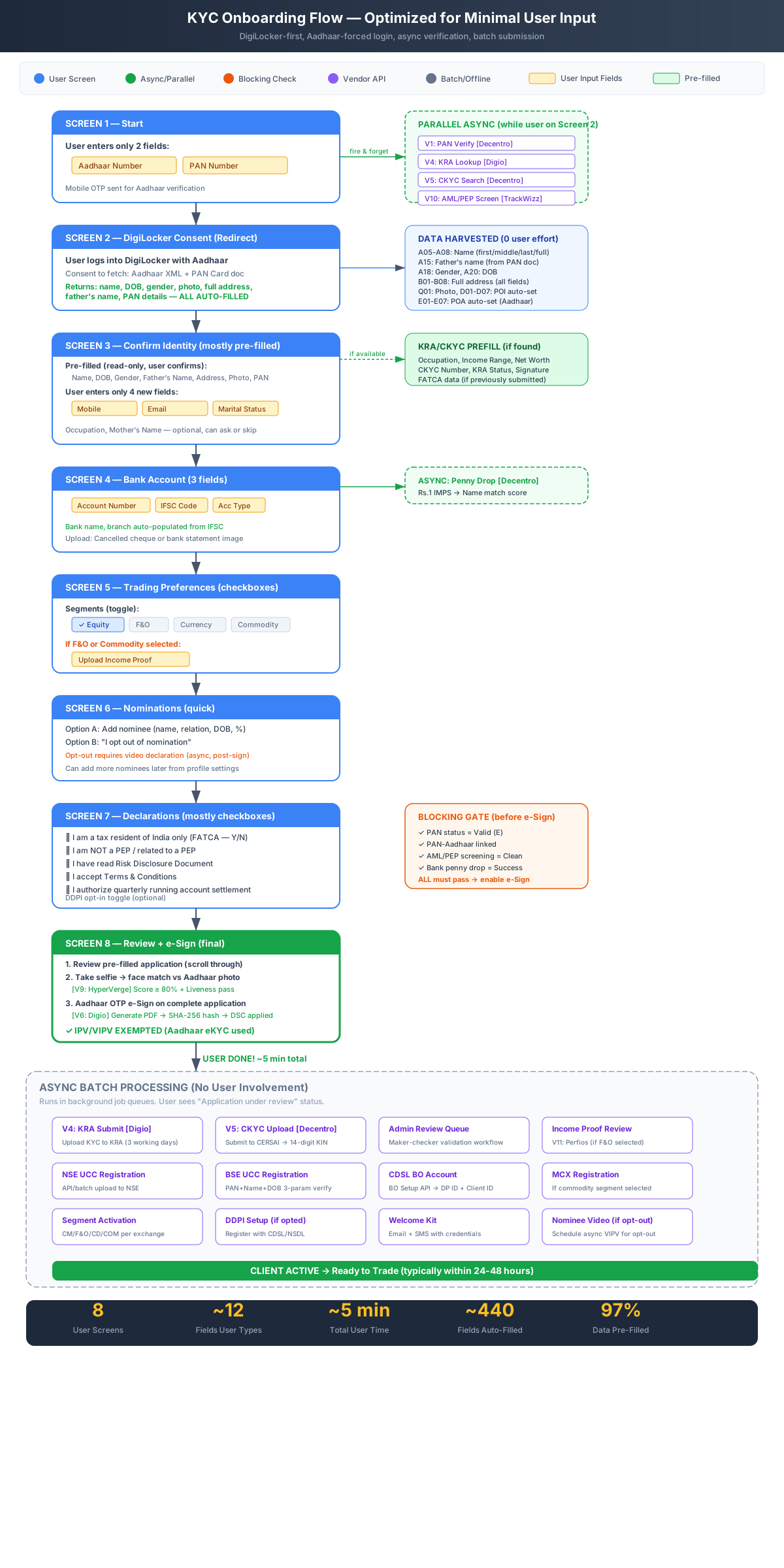
Complete Onboarding Flow — 9 Screens + Maker-Checker + Batch Pipelines
Here are the key dimensions of the system, derived from SEBI regulatory requirements and the KRA/CKYC/exchange/depository submission mandates.
Multi-Step Identity Verification
Mobile OTP → PAN verification → Government identity source (DigiLocker/Aadhaar) → identity confirmation → bank verification → trading preferences → nominations → declarations → eSign.
Comprehensive KYC Data Capture
Government identity sources (DigiLocker, KRA, CKYC) provide pre-verified identity and financial data, minimizing manual data entry errors per SEBI KYC norms.
Identity, KRA, Exchange & Depository Integrations
PAN verification (NSDL/Protean), KRA agencies, CKYC (CERSAI), DigiLocker, eSign, AML screening, biometric verification, exchanges (NSE/BSE/MCX), and depositories (CDSL/NSDL). See Vendor Integrations for implementation options.
8 Regulatory Batch Pipelines
KRA, CKYC, NSE, BSE, MCX, CDSL, NSDL, and Income pipelines run asynchronously after maker-checker approval per SEBI dual-control requirements.
The table below maps each section to what you will find inside. Use it as a reference whenever you need to locate a specific topic.
| Section | What You’ll Find |
|---|---|
| Architecture | Regulatory design principles, onboarding flow overview, data source mapping, security requirements |
| User Journey | Detailed specification for each onboarding step with SEBI-mandated data capture requirements |
| Vendor Integrations | Deep-dive specs for identity, KRA, eSign, AML, exchange, and depository integrations |
| Operations | Batch pipelines, exchange registration, 6-attribute matching, admin workflow, status machine |
| Reference | Full 454-field master dataset, code tables, regulatory circulars, cost analysis, architecture diagrams |
| Appendix | Non-individual entities, NRI flows, minor/joint accounts, vendor roadmap, communications |
These are the circulars and regulations that govern everything in this specification. You will see them referenced throughout the docs. Bookmark this table — you will come back to it often. For the full list of 37+ circulars with official links, see the Regulatory Circulars page.
| Regulation | Reference |
|---|---|
| SEBI KYC Master Circular | SEBI/HO/MIRSD/MIRSD-SEC-2/P/CIR/2023/168 (Oct 2023) |
| KYC Process & Technology (Online KYC, VIPV) | SEBI/HO/MIRSD/DOP/CIR/P/2020/73 (Apr 2020) |
| KYC Simplification at KRAs | SEBI/HO/MIRSD/FATF/P/CIR/2023/0144 (Aug 2023) |
| PAN-Aadhaar Linking Relaxation | SEBI/HO/MIRSD/SECFATF/P/CIR/2024/41 (May 2024) |
| Dual KRA + CKYC Upload | SEBI/HO/MIRSD/SECFATF/P/CIR/2024/79 (Jun 2024) — mandatory since Aug 2024 |
| FATCA/CRS Centralization at KRAs | SEBI/HO/MIRSD/SECFATF/P/CIR/2024/12 (Feb 2024) — mandatory since Jul 2024 |
| AML/CFT Guidelines | SEBI/HO/MIRSD/SECFATF/P/CIR/2024/78 (Jun 2024) |
| DDPI replacing POA | SEBI/HO/MIRSD/DoP/P/CIR/2022/44 (Apr 2022) — mandatory since Nov 2022, optional for clients |
| Nomination Revamp (up to 10 nominees) | SEBI circular (Jan 10, 2025) — video verification for opt-out |
| DigiLocker for Demat Holdings | SEBI/HO/OIAE/OIAE_IAD-3/P/CIR/2025/32 (Mar 2025) |
| SEBI Stock Brokers Master Circular | SEBI/HO/MIRSD/MIRSD-PoD/P/CIR/2025/90 (Jun 2025) |
| SEBI Stock Brokers Regulations 2026 | SEBI/LAD-NRO/GN/2026/291 (Jan 7, 2026) — replaces 1992 regulations |
| Client Fund Upstreaming | SEBI/HO/MIRSD/MIRSD-PoD-1/P/CIR/2023/84 (Jun 2023) |
| UPI Block Mechanism (QSBs) | SEBI consultation paper (Aug 2024) — mandatory from Feb 1, 2025 |
| T+0 Settlement | SEBI/HO/MRD/MRD-PoD-3/P/CIR/2024/20 (Mar 2024) — expanded to top 500 stocks Dec 2024 |
| e-KYC Setu (NPCI) | SEBI press release (Jun 2025) — Aadhaar e-KYC without AUA/KUA license |
| UPI AutoPay Rs 1 Lakh Limit | RBI/2023-2024/88 + NPCI/UPI/OC-151A (Dec 2023) — MCC 6211 securities brokers |
| Account Aggregator Master Direction | RBI/DNBR/2016-17/46 (Sep 2016, updated Sep 2024) |
| DPDP Act 2023 + Rules 2025 | Notified Nov 13, 2025 — full compliance deadline May 2027 |
| KYC Onboarding Consultation Paper | SEBI (Jan 16, 2026) — proposes centralized KYC, 5-year review cycle |