Part 04 — Digital & Embedded Lending
LaaS Platforms & Case Studies
This page corrects one naming issue upfront. The platform found in public sources is Glaas, not “GLASS”. Glaas is operated by Gromor Finance Private Limited according to its terms, and the site describes “Gromor Lending as a Service” style embedded credit infrastructure. It is not U GRO Capital’s platform. U GRO Capital’s lending-as-a-service and co-lending stack is publicly associated with GRO Xstream, GRO Score and embedded financing, not Glaas. The task label “GLASS / U GRO Capital’s lending-as-a-service” is therefore a conflation of two different businesses: Gromor/Glaas and U GRO/GRO Xstream.
Gromor Finance And Glaas
Section titled “Gromor Finance And Glaas”Gromor Finance’s main site says it provides small business loans such as working-capital loans, equipment financing and growth capital, and states that it is registered with RBI as a non-banking financial company (NBFC) with Certificate of Registration No. N-13.01336 (Gromor Finance). Its terms page adds a nuance: loan processing and sanction are at the discretion of “Gromor Finance (registered as an NBFC under the name of Sahayata Savings and Investments Private Limited) / any affiliated lenders” (Gromor terms). Because public pages use both Gromor Finance and the underlying NBFC name, a credit system should store both the customer-facing brand and the legal lender name.
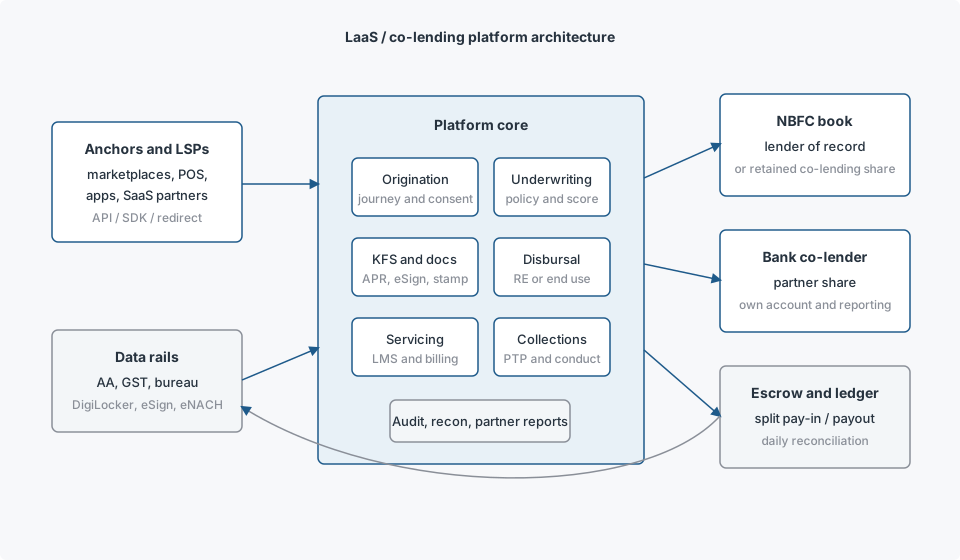
Glaas describes itself as embedded credit infrastructure with API/SDK integration, sandbox, white-label or native user experience, custom underwriting, monitoring and collections, and says it operates through Gromor Finance as a licensed NBFC (Glaas). Its terms define platform partners, co-lending partners and borrowers, and describe services including origination, underwriting, disbursement, monitoring and collections (Glaas terms). The model is closer to full-stack LaaS than a pure lead marketplace: the platform can bring merchants, Glaas supplies the lending stack and Gromor or co-lenders hold regulated exposure.
Fund flow should follow RBI digital lending rules: disbursal from the regulated entity’s account to the borrower or permitted end-beneficiary, repayment to the RE account, and platform fees paid by the RE, not separately collected by the LSP. If Glaas/Gromor provides co-lending orchestration, the co-lending escrow and split-ledger rules apply.
U GRO Capital And GRO Xstream
Section titled “U GRO Capital And GRO Xstream”U GRO Capital is a listed DataTech NBFC focused on MSME lending. Its site reports ₹15,334 crore assets under management (AUM), 317 branches and about 3.21 lakh customers as of March 2026, and describes GRO Score 3.0 using bureau, bank statement and GST data (U GRO about). Its embedded financing page lists unsecured products up to ₹5 lakh, tenors up to 12 months, platform transaction data, bank statements and GST details, with disbursal “instantly or within hours” after approval (U GRO embedded financing).
Public news and company material associate U GRO’s LaaS model with GRO Xstream, a platform integrating with banks, NBFCs and fintechs for co-lending and liability partnerships. Moneycontrol’s 2023 coverage says U GRO had built a LaaS book of more than 15 percent of AUM through GRO Xstream at that time (Moneycontrol, April 6, 2023). Its lender/LSP disclosure page lists digital lending app partners including Lendingkart, MobiKwik for Business, PhonePe Business, BharatPe, Meesho, Rupifi, GetVantage, Recur, Shiprocket and others (U GRO LSP page).
U GRO’s credit risk is primarily that of a regulated NBFC and co-lender, not merely a technology vendor. It originates, underwrites through its policy/GRO Score, services and holds or shares exposure with partner REs.
Yubi Co.Lend
Section titled “Yubi Co.Lend”Yubi Co.Lend is a co-lending marketplace/operating system, not an NBFC lender in the ordinary borrower-facing sense. Its product page on LinkedIn says it enables lenders to discover, go live and collaborate with multiple partners with one-time API integration and claims over ₹5,000 crore loan disbursements and 80,000 transactions per day in the referenced product material (Yubi Co.Lend LinkedIn product). Yubi’s SBI partnership announcement described Yubi Co.Lend as an end-to-end solution for lenders to collaborate through quick API integration, and said Yubi would help build, manage and monitor SBI’s co-lending portfolio (Financial Express, September 27, 2022).
The operating model is lender-to-lender infrastructure. Credit risk remains with the participating REs according to their co-lending shares. Yubi monetizes technology and workflow, not borrower interest spread. Its value is partner discovery, API integration, loan-level data exchange, payout/pay-in workflow, compliance monitoring and reconciliation.
Razorpay Capital
Section titled “Razorpay Capital”Razorpay Capital is embedded credit for existing Razorpay merchants. Razorpay documentation says Capital includes instant settlements, working-capital loans, cash advance and corporate cards; working-capital loans are offered through NBFC partners and invitations are based on internal transaction data (Razorpay Capital docs, working-capital loans). Its cash advance docs describe an unsecured line of credit where withdrawals become short-term loans, interest starts at 0.05 percent per day, and repayment can be automatic as a percentage of settlements (Razorpay cash advance).
Razorpay’s advantage is settlement data: volume, refunds, chargebacks, fraud flags and seasonality. For working-capital loans, credit risk sits with the lender/NBFC partner; Razorpay is the platform/LSP and repayment facilitator. For instant settlement, the economics may be a fee for early access to receivables rather than a standard term-loan spread.
Pine Labs
Section titled “Pine Labs”Pine Labs is primarily merchant commerce, payments and affordability infrastructure. Its pay-later/affordability pages emphasize card, NBFC, UPI and cardless EMI options, 40+ credit partners and 350+ brand partners (Pine Labs Pay Later). Its fintech infrastructure page positions lending as plug-and-play financial infrastructure on digital rails (Pine Labs fintech infrastructure).
For SME lending, Pine Labs’ strongest embedded position is POS and merchant transaction data. Historically, merchant finance through POS partners has used swipe/settlement data to size advances and deduct repayments from future card/UPI settlements. Pine Labs itself should be treated as infrastructure/platform unless a specific regulated lender in the transaction is identified. Credit risk sits with bank/NBFC credit partners.
Rupifi
Section titled “Rupifi”Rupifi is B2B embedded payments and credit. Its official site offers B2B credit, checkout, embedded credit, split payments and reconciliation, with net terms of 15/30/45/60/90 days. It says partner marketplaces can see GMV growth and get paid instantly, and cites powering more than 50,000 retailers/SMEs for Walmart with ₹1,000 crore-plus credit transaction payment volume (Rupifi). Its terms state Rupifi may offer BNPL, short-term credit and other technology-enabled services with partner merchants and partner financial institutions, and that for credit-line transactions a partner financial institution grants the credit line at its discretion (Rupifi terms).
This is an anchor-credit model: marketplace or brand checkout embeds a credit option, Rupifi handles journey, limit/reconciliation and lender connectivity, and the lender or partner financial institution holds regulated risk unless a permitted DLG exists.
FlexiLoans
Section titled “FlexiLoans”FlexiLoans is the trade name of Epimoney Private Limited, an RBI-registered NBFC according to its site (FlexiLoans about). It reports ₹7,000 crore-plus loans disbursed, 2,100-plus cities served and 400-plus partners. Its partner page lists API integration, partner portal and redirection models, with partner categories including LSPs, e-commerce partners and POS partners; it advertises collateral-free business loans of ₹1 lakh to ₹50 lakh and 48-72 hour approval (FlexiLoans partner page).
FlexiLoans can act as lender of record using its NBFC balance sheet, as co-lender with financial partners, or as platform technology for partner-originated journeys. The presence of named financial partners means a borrower file must identify the actual lender and whether FlexiLoans is the RE, co-lender, LSP or servicer.
Indifi
Section titled “Indifi”Indifi describes itself as a technology platform that gathers and analyses business data, takes applications to multiple lenders and creates choice for lenders (Indifi about). Its main site offers term loans, line of credit, invoice discounting and merchant cash advance, including up to ₹1 crore in under 24 hours, subject to eligibility (Indifi). Its lending-partners page lists Indifi Capital Private Limited and other lenders, with examples such as business loans up to ₹100 lakh, tenors up to 36 months and APR ranges by lender (Indifi lending partners).
Indifi is therefore both a marketplace/LSP and, through Indifi Capital Private Limited, part of a lending structure. Credit risk depends on the named lender in the KFS. Its economics likely include sourcing/service income plus lender economics where its group NBFC participates.
GetVantage
Section titled “GetVantage”GetVantage positions itself as embedded finance and growth capital for MSMEs, startups and entrepreneurs. Its about page says it has served nearly 2,000 businesses and that GetGrowth Capital is an RBI-licensed NBFC, while also disclosing that GetVantage Tech Private Limited itself is not an NBFC and is not regulated by NBFC regulations (GetVantage about). Its funding model is revenue-based or cash-flow-based financing: no equity dilution, no board seat, no collateral, flexible repayment as a percentage of revenues, underwriting in 1-2 weeks and minimum revenue of ₹5 lakh per month.
This is an important attribution correction: the fintech platform and the licensed NBFC are not the same legal entity. A borrower journey may be branded GetVantage, but regulated lending may be by GetGrowth Capital, another NBFC, a bank or a funding partner. The system must capture the lender-of-record, revenue-share repayment logic and any investor/funding-partner participation separately.
Sources
Section titled “Sources”- Gromor Finance
- Gromor Finance terms and conditions
- Glaas embedded credit infrastructure
- Glaas terms of service
- U GRO Capital about
- U GRO Capital embedded financing
- U GRO Capital LSP/DLA disclosures
- Moneycontrol on U GRO GRO X and GRO Xstream, April 6, 2023
- Yubi Co.Lend LinkedIn product page
- Financial Express on Yubi-SBI co-lending, September 27, 2022
- Razorpay Capital documentation
- Pine Labs Pay Later
- Rupifi
- FlexiLoans about
- Indifi about
- GetVantage about