Part 05 — The Lending Lifecycle
Underwriting Decisioning
Purpose
Section titled “Purpose”Underwriting decisioning converts the data pack into a credit outcome: approve, reject, reduce, price higher, ask for collateral, seek guarantor, raise deviation or send for more due diligence. The decision must be explainable to credit committee, audit, partner lenders and sometimes the borrower. In practice, the central artefact is the credit appraisal memorandum (CAM) or credit note.
For a full worked appraisal package that chains data inputs, CMA schedules, eligibility methods and the CAM recommendation, see The Credit Appraisal Package.
For the implementation spec of the business rules engine that computes eligibility, pricing, deviations, reason codes and co-lending allocation, see BRE functional specification and BRE runtime architecture.
Actors
Section titled “Actors”Actors are credit analyst, credit manager, risk policy, business approver, credit committee, RCU, legal/technical teams for secured conditions, sales for negotiation, operations for condition capture and partner credit desk in co-lending. Analytics owns scorecards and BRE monitoring, but credit owns final judgment within delegation of authority.
Inputs & documents
Section titled “Inputs & documents”Inputs come from underwriting data: bureau reports, bank analysis, GST/ITR/financials, obligations, collateral estimate, FI/PD notes if already available, product policy and pricing grid. Decisioning also uses internal exposure, group exposure, fraud markers, negative list, industry outlook and customer relationship history.
Step-by-step workflow
Section titled “Step-by-step workflow”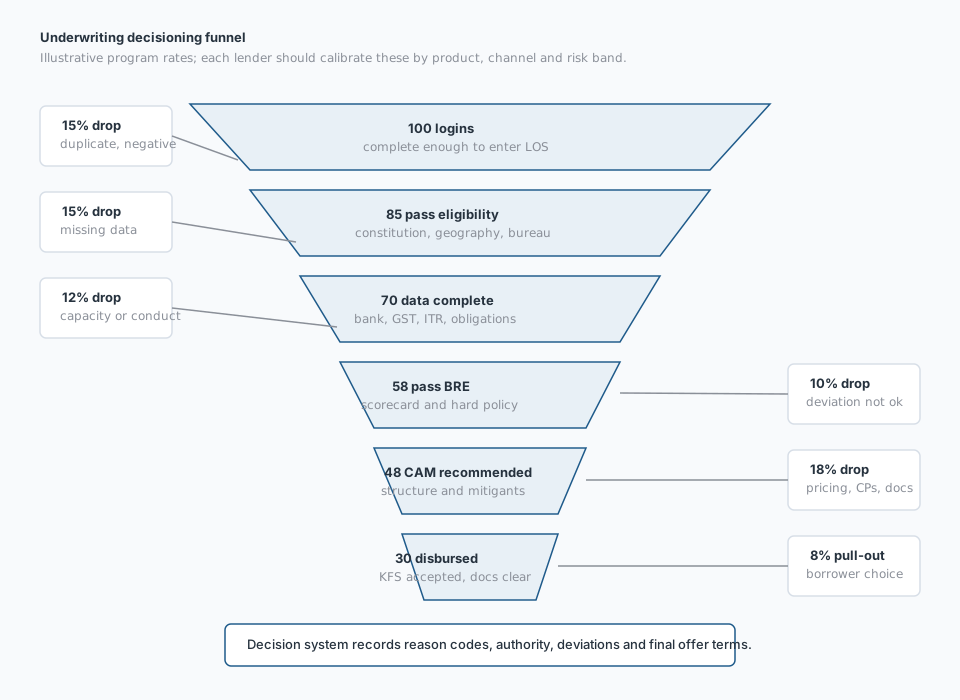
- Validate applicant and product eligibility: constitution, age, vintage, geography, industry, ticket, tenor and end use.
- Compute repayment capacity. For an unsecured business loan, use FOIR where income is assessed monthly; for term loans, use DSCR; for working capital, use turnover, drawing power and working-capital cycle.
- Apply scorecard/BRE rules: bureau score/CMR, delinquency, enquiries, bank bounces, ABB, GST filing discipline, debtors, profitability, leverage and collateral LTV.
- Decide structure: amount, tenor, rate, processing fee, collateral, guarantee, escrow/standing instruction, insurance, conditions precedent and post-disbursement covenants.
- Raise deviations where a proposal fails policy but is still supportable: lower vintage, thin bureau, high FOIR, lower margin, negative FI mitigated by collateral, or financials pending audit.
- Prepare CAM with recommendation, rationale, risks, mitigants and approval authority.
- Record decision and reason codes. Rejections should use specific reasons rather than generic “policy decline”.
Worked examples
Section titled “Worked examples”FOIR example: A trader has assessed monthly business surplus of ₹2.20 lakh. Existing EMIs are ₹52,000. Policy maximum fixed obligation to income ratio is 60%. Maximum total EMI is ₹1.32 lakh, leaving ₹80,000 EMI capacity. At 18% p.a. for 36 months, EMI per ₹1 lakh is roughly ₹3,615, so indicative eligibility is about ₹22 lakh before bureau, vintage and policy caps.
DSCR example: A machinery loan needs annual debt service of ₹18 lakh. The business has projected cash accrual of ₹31 lakh after normal working-capital needs. DSCR is 1.72x. If policy asks for minimum 1.35x, capacity is acceptable; if the projection relies on an unconfirmed new order, credit may haircut cash accrual by 20%, giving DSCR 1.38x and requiring closer covenants.
Turnover example: A GST-registered wholesaler has average annual GST turnover of ₹8 crore and bank credits of ₹7.2 crore. A conservative unsecured program may cap exposure at 8%-12% of verified turnover, so ₹58-86 lakh before obligations. A cash-credit assessment may instead use projected turnover, margin, inventory/debtor cycle and drawing-power controls.
Exceptions & edge cases
Section titled “Exceptions & edge cases”The real art is resolving contradictions. Strong bank credits with weak ITR may justify surrogate assessment for a micro borrower, but not for a ₹3 crore exposure. High CMR can be mitigated by cleared delinquency, collateral and improved conduct, but suit-filed, wilful default or recent settlement normally triggers hard decline or senior committee. Low FOIR can still be unsafe if revenue is concentrated in one buyer with delayed payments. Good collateral does not fix fraudulent documents or unwillingness to pay.
Deviation matrices should define who can approve what: credit manager for minor FOIR breach up to 5 percentage points, regional credit head for vintage shortfall, national credit head for CMR 7 with mitigants, committee for policy exceptions above ₹1 crore or negative RCU with business justification. Deviations need expiry; old approvals should not be reused after data changes.
Systems touched
Section titled “Systems touched”BRE, scorecard service, LOS credit workflow, CAM generator, delegation-of-authority matrix, pricing engine, collateral system, deviation module, committee minutes, audit log and KFS generator. Since RBI’s KFS circular requires APR and all charges to be disclosed before execution for MSME term loans, decisioning must pass final pricing and fee data to the KFS process (RBI KFS circular, 15 April 2024).
TATs/SLAs
Section titled “TATs/SLAs”Automated small-ticket approvals can be instant to 2 hours after data completion. Analyst-led unsecured files up to ₹50 lakh usually target same day or next day. Secured loans and working-capital proposals above ₹1 crore typically need 2-5 working days after complete data, longer if committee cadence is weekly. Deviations should have explicit SLAs, commonly 4 business hours for minor deviations and 1-2 working days for committee-level deviations.
Stage metrics
Section titled “Stage metrics”Track approval rate, reject reason mix, average sanctioned amount versus requested amount, deviation rate, deviation approval rate, CAM rework rate, decision TAT, model override rate, pricing exceptions, pull-through to disbursement, first-payment default, 30+ days past due by score band and vintage bad rate. A healthy credit process back-tests decisions: which approved deviations performed, and which hard rules rejected potentially good business.
Co-lending/partner-origination variant
Section titled “Co-lending/partner-origination variant”Co-lending decisioning may be sequential, parallel or delegated within policy. Under the 2025 co-lending directions, each regulated entity should incorporate co-lending provisions into credit policy, including target borrower segments, partner due diligence and customer service mechanisms (RBI Co-Lending Arrangements Directions, 2025). The system must store dual decision status: originator_approved, partner_approved, partner_cutback_amount, blended_rate and final borrower offer. If the partner rejects after originator approval, the originator can either hold 100% exposure within policy or cancel/restructure the offer before KFS acceptance.