Part 05 — The Lending Lifecycle
Documentation Security
Purpose
Section titled “Purpose”Documentation and security creation make the sanction legally enforceable. This stage turns approved terms into executed loan documents, creates charges over movable or immovable assets, registers those charges where required, and stores evidence that the lender can rely on in recovery. It sits between sanction and disbursement, and it is where many “approved” SME loans get delayed.
The core principle is simple: money should not go out until the lender has the documents, stamps, signatures, mortgage/hypothecation, guarantees, and registration tasks needed for the specific product. The details are not simple, because stamping is state-specific, mortgage practice varies by state and document type, e-sign acceptability depends on product and counterparty, and corporate borrowers need ROC charge filings in addition to CERSAI filings.
Actors
Section titled “Actors”Operations owns the checklist and maker-checker process. Legal approves document formats, mortgage creation, and exceptions. The borrower, co-borrowers, guarantors, property owners, directors, partners, karta, or trustees sign depending on constitution. The RM helps schedule signing but should not waive documents. Vendors include e-stamp providers, e-sign providers such as NSDL e-Gov, Protean, Digio, Leegality, and SignDesk, CERSAI filing users, ROC professionals or company secretaries, and document-custody vendors.
Inputs & Documents
Section titled “Inputs & Documents”The packet normally includes sanction letter acceptance, Key Facts Statement (KFS) where applicable, loan agreement, demand promissory note for some bank products, deed of hypothecation, deed of guarantee, board/partner/LLP resolutions, personal guarantee, post-dated cheque or security cheque only where the lender’s policy permits, NACH/eNACH mandate, mortgage memorandum, title deposit receipt, property insurance, original title deeds, and security perfection checklist.
RBI’s KFS circular matters here because the KFS must be included as a summary box in the loan agreement and charges not disclosed in the KFS cannot be charged later without explicit consent (Key Facts Statement for Loans & Advances, April 15, 2024). For digital loans, fund flows and lending service provider (LSP) controls are governed by the 2025 Digital Lending Directions, which also retain data, grievance, and direct-flow requirements (Reserve Bank of India (Digital Lending) Directions, 2025, May 8, 2025).
Step-By-Step Workflow
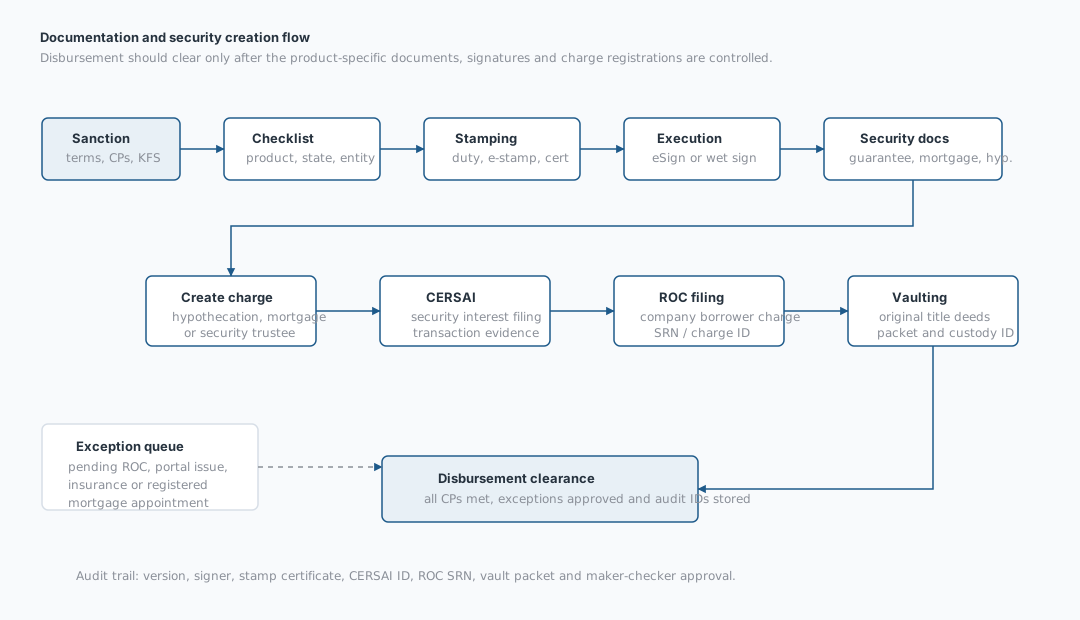
Section titled “Step-By-Step Workflow”- Operations generates a document checklist from product, borrower constitution, state, sanction conditions, collateral type, and co-lending flag.
- Stamp duty is calculated. Loan agreements, hypothecation deeds, guarantees, indemnities, and mortgage documents may attract different duties under the Indian Stamp Act, 1899 or the relevant state stamp act. E-stamping through StockHolding Corporation of India (SHCIL) is common but not universal across every document and state.
- Execution mode is selected. Wet ink is still common for mortgages, guarantees, and high-ticket secured cases. eSign is used for many unsecured and digital workflows; the Controller of Certifying Authorities describes eSign as an online electronic-signature service using licensed certifying authorities under the Information Technology Act, 2000 (CCA eSign service).
- Guarantees and security-provider documents are executed by the correct persons. A private company needs board authorization; an LLP needs designated partner authority; a partnership requires authority under the partnership deed; Hindu Undivided Family (HUF) cases need karta and coparcener handling as per lender policy.
- Security is created. Movable assets are usually charged by hypothecation. Immovable property may be secured through equitable mortgage by deposit of title deeds, registered mortgage, English mortgage, or simple mortgage depending on state practice, property type, and legal opinion.
- Charge registrations are filed. CERSAI registration flows from the SARFAESI central registry framework (SARFAESI Act, 2002, section 20); operational rules require particulars of covered transactions to be filed within prescribed timelines, commonly 30 days under the SARFAESI (Central Registry) Rules, 2011. For company borrowers, section 77 of the Companies Act, 2013 requires registration of charges with ROC within 30 days of creation, with delayed routes subject to additional requirements (Companies Act, 2013, section 77, India Code).
- Original documents are logged into vault custody with barcode, packet ID, fire-safe location, and release authorization rules.
Exceptions & Edge Cases
Section titled “Exceptions & Edge Cases”The most common exception is “disburse now, perfection later”. It should be rare and expressly approved. Examples include pending ROC challan due to MCA portal downtime, insurance endorsement pending from insurer, CERSAI delayed because the portal rejects property metadata, or registered mortgage appointment available only after disbursal date. These should be conditions subsequent with owner, due date, and auto-escalation.
Stamping errors are expensive. Under-stamped agreements can become inadmissible until duty and penalty are paid. Multi-state lending requires rule engines: Maharashtra, Karnataka, Tamil Nadu, Delhi, Gujarat, and Telangana can produce materially different duty outcomes. The system should not treat “e-stamp available” as “this document is validly stamped”.
Another nuance is guarantee enforceability. Personal guarantees from promoters are routine, but spousal signatures, non-owner family guarantees, and elderly guarantors require capacity and coercion checks. For machinery, the lender should match invoice, serial number, installation photo, and insurance asset description. For stock and book debts, a floating hypothecation deed without monitoring discipline is weak security.
Systems Touched
Section titled “Systems Touched”LOS, document-generation engine, stamp-duty engine, e-stamp provider, e-sign provider, DMS, CERSAI portal, MCA/ROC portal, vault/custody system, LMS collateral module, and exception-management queue. Audit trails must capture document version, signer identity, IP/device evidence for e-sign, stamp certificate number, CERSAI transaction ID, ROC SRN/charge ID, and custodian receipt.
TATs/SLAs Typical In Industry
Section titled “TATs/SLAs Typical In Industry”Unsecured e-sign documentation can close in 30 minutes to one day. Wet-sign unsecured files usually take 1-3 working days. LAP documentation with original title deposit, mortgage memorandum, and CERSAI filing normally takes 2-5 working days after sanction acceptance; registered mortgage can add 3-10 working days depending on sub-registrar availability. ROC filing should be initiated immediately after charge creation, not near day 30.
Stage Metrics
Section titled “Stage Metrics”Track documentation-first-time-right, stamp defects, e-sign failure rate, pending CPs, CERSAI filing within SLA, ROC filing within SLA, original-title custody pending, exception ageing, and disbursement blocked due to documentation. Security quality metrics include collateral packets without original deed, charge satisfaction not filed after closure, and insurance policies missing lender clause.
Co-Lending/Partner-Origination Variant
Section titled “Co-Lending/Partner-Origination Variant”Co-lending adds document complexity. The borrower agreement must disclose roles and single customer interface under the 2025 Co-Lending Directions, and each RE maintains its own borrower account for its share. The security documents must say whether security is held pari passu, through a security trustee, or in favour of one lender for itself and as agent/trustee for the other. The CERSAI and ROC filings should match the legal structure; a mismatch between sanction split and registered charge is a real operational risk.
Sources
Section titled “Sources”- Key Facts Statement for Loans & Advances, RBI, April 15, 2024
- Reserve Bank of India (Digital Lending) Directions, 2025, May 8, 2025
- SARFAESI Act, 2002 - Central Registry, India Code
- Companies Act, 2013 - Registration of Charges, India Code
- CCA eSign Online Electronic Signature Service
- Reserve Bank of India (Co-Lending Arrangements) Directions, 2025, August 6, 2025