Part 06 — Collections & Recovery
Delinquency Fundamentals
Delinquency is not “customer has not paid” in the loose sense. In a regulated lender it is a clock, an accounting trigger, a collections queueing rule, a bureau reporting input and eventually a legal-recovery precondition. The clock starts from the exact due date written in the sanction letter or loan agreement. RBI required lenders to specify exact due dates, repayment frequency, principal-interest breakup and examples of SMA/NPA classification in loan documents through its Prudential norms on IRACP - Clarifications circular dated November 12, 2021.
DPD Math
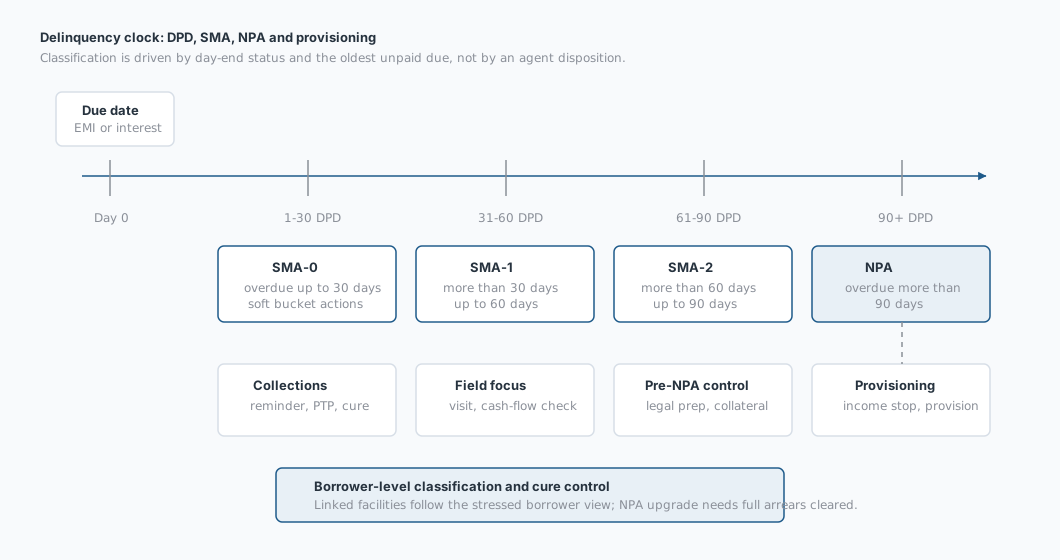
Section titled “DPD Math”Days past due (DPD) is counted at facility level first. If an equated monthly instalment (EMI) of ₹1,25,000 is due on July 5 and the lender’s day-end process runs without full payment, the account is overdue from July 5. If nothing is paid, July 6 is normally 1 DPD in operational reporting, while RBI’s classification date examples are based on the day-end status of the relevant calendar date. RBI clarified that overdue, Special Mention Account (SMA) and Non-Performing Asset (NPA) tagging must happen as part of the day-end process for the date concerned, irrespective of when the batch job runs (RBI IRACP clarification, paras 4-5, November 12, 2021).
Typical SME lenders maintain both:
| Field | Practical use |
|---|---|
| Current DPD | Queueing today: 0, 1-30, 31-60, 61-90, 90+. |
| Max DPD in month | Behaviour score, bureau reporting quality checks and bounce analysis. |
| Amount overdue | True cure amount, including EMI, interest, charges and mandate bounce charges where contractually due. |
| Oldest unpaid due date | The source of bucket movement; partial payments do not reset it unless the oldest arrear is cleared. |
Example: a machine loan has EMIs due on May 10, June 10 and July 10. The borrower pays one EMI on July 18. If the payment is appropriated to the oldest arrear, May is cleared and June 10 becomes the oldest unpaid due date. If the agreement and system instead appropriate first to charges or current dues, DPD may not cure. This is why servicing must define repayment appropriation, and collections agents must be shown the exact cure amount, not only “one EMI due”.
Buckets Used In Collections
Section titled “Buckets Used In Collections”Operational buckets are not identical to RBI asset classes, but they map to them.
| Collections bucket | Meaning in practice | Typical action |
|---|---|---|
| X / pre-due | Due in next 3-7 days or mandate presented | Reminder, balance check, UPI/autopay fallback. |
| 1-7 DPD | Early delinquency, often mandate bounce or cash-flow timing | Telecalling, payment link, Promise to Pay (PTP). |
| 8-30 DPD | Soft bucket | Field verification for higher tickets, partner escalation. |
| 31-60 DPD | Harder bucket; SMA-1 for term loans | Senior caller, field visit, business cash-flow check. |
| 61-90 DPD | Pre-NPA; SMA-2 | Legal notice preparation, collateral review, OTS screening. |
| 90+ DPD | NPA for most SME term loans and bills | Legal route, repossession/security enforcement, ARC/OTS evaluation. |
The “X bucket” is common in Indian collections floors: accounts are not overdue yet but are likely to bounce because the EMI date is close and the customer’s settlement account balance is weak. For payment-processor merchant finance, an X bucket may mean the daily settlement sweep for the week is short of the expected holdback amount. For cash credit (CC) and overdraft (OD), a lender may run “pre-out-of-order” flags when the outstanding is above drawing power or credits are not covering interest.
SMA And NPA
Section titled “SMA And NPA”RBI’s SMA ladder for loans other than revolving facilities is simple: SMA-0 means principal, interest or any other amount is wholly or partly overdue up to 30 days; SMA-1 is more than 30 days and up to 60 days; SMA-2 is more than 60 days and up to 90 days (RBI Master Circular on IRAC for banks, April 1, 2025). An NPA is triggered when interest or instalment remains overdue for more than 90 days for a term loan, or a bill remains overdue for more than 90 days (RBI Master Circular on IRAC for banks, para 2.1.2, April 1, 2025).
CC/OD accounts use “out of order” logic. The account is out of order if the outstanding remains continuously above the sanctioned limit or drawing power for 90 days, or if it is within limit but has no credits for 90 days, or credits are insufficient to cover interest debited during the previous 90 days (RBI Master Circular on IRAC for banks, para 2.2, April 1, 2025). This is where SME systems often fail. An EMI engine cannot classify a working-capital line correctly unless it ingests drawing power, stock statements, interest debits, credit turnover and renewal status. See working capital products and monitoring EWS.
Borrower-Level Classification
Section titled “Borrower-Level Classification”For one lender, asset classification is borrower-wise, not facility-wise. If Ganesh Auto Components has a ₹40 lakh term loan, ₹25 lakh machinery loan and ₹60 lakh cash-credit line with the same bank, and the machinery loan becomes NPA, the bank should classify the borrower’s facilities consistently as NPA unless a specific exception applies. RBI’s November 12, 2021 clarification also says an NPA can be upgraded to standard only when the entire arrears of interest and principal are paid by the borrower; for multiple facilities, the arrears across all credit facilities must be cleared (RBI IRACP clarification, para 10, November 12, 2021).
Example:
| Facility | Status on July 31 | Stand-alone DPD | Borrower-level result |
|---|---|---|---|
| Term loan | June EMI unpaid, July EMI unpaid | 51 DPD | SMA-1 |
| Cash credit | Within drawing power, interest serviced | 0 DPD | Still SMA-1 at borrower level for this lender’s reporting discipline. |
| Equipment loan | Current | 0 DPD | Still linked to borrower stress view. |
If the term loan crosses 90 DPD and becomes NPA, collections cannot treat the CC line as a clean renewal candidate. The lender may still manage each facility operationally, but credit risk, income recognition and bureau reporting need a borrower-level view.
Co-lending adds another layer. RBI’s Co-Lending Arrangements Directions, August 6, 2025 require borrower-level asset classification for each regulated entity’s exposure under the co-lending arrangement: if either RE classifies its exposure to a borrower under the CLA as SMA/NPA because of default in the CLA exposure, the same classification applies to the other RE’s CLA exposure, with information shared near real time and at latest by end of next working day. The collections system therefore needs partner-status ingestion, not only internal DPD.
Cure, Roll And Stabilisation
Section titled “Cure, Roll And Stabilisation”“Collected one EMI” is not a cure if arrears remain. A proper cure rule says:
- Clear all amounts needed to make the oldest unpaid due date current.
- Reverse bucket only after posting, not after receiving an unverified UPI screenshot.
- For NPA upgrade, ensure all arrears of principal and interest across linked facilities are cleared.
- Keep a watch period for operational collections even if regulatory classification improves.
Roll rates are the key management metric. A ₹100 crore unsecured business-loan book with ₹4 crore in 1-30 DPD may look manageable, but if 30% rolls to 31-60 and 45% of 31-60 rolls to 61-90, the next-quarter credit cost is already visible. Secured Loan Against Property (LAP) books usually roll slower because borrower equity and property pressure matter; app-led unsecured merchant loans can roll faster when sales decline or settlement accounts are changed. These are portfolio observations, not RBI rules; each lender should validate them through vintage curves as explained in portfolio analytics.
System Discipline
Section titled “System Discipline”The minimum data model is borrower, facility, due, billing, repayment, appropriation, overdue amount, oldest overdue date, current DPD, max DPD, SMA/NPA status, status effective date, cure amount and reason code. For CC/OD, add sanctioned limit, drawing power, outstanding, interest debited, credits in previous 90 days and review/renewal due date.
The hard control is immutability. A branch user should not edit DPD. The system should recompute it from dues, repayments, reversals and approved waivers, then write an auditable classification event. Manual overrides may exist for court stay, natural calamity rescheduling or operational error, but they need maker-checker approval and a reason code because they affect IRAC, provisioning, Credit Information Company (CIC) reporting and collection queues.
Sources
Section titled “Sources”- RBI Prudential norms on IRACP - Clarifications, November 12, 2021
- RBI Prudential norms on IRACP - Clarifications, February 15, 2022
- RBI Master Circular - Prudential norms on Income Recognition, Asset Classification and Provisioning pertaining to Advances, April 1, 2025
- RBI Co-Lending Arrangements Directions, August 6, 2025