Part 06 — Collections & Recovery
Legal Toolkit
Legal recovery in SME lending is a choice of route, not a single escalation button. The right route depends on security, borrower constitution, amount due, documents, geography, cost and urgency. A ₹9 lakh unsecured proprietor loan, a ₹75 lakh machinery loan with hypothecation and a ₹3 crore LAP facility to a private company should not travel the same path.
Route Selection
Section titled “Route Selection”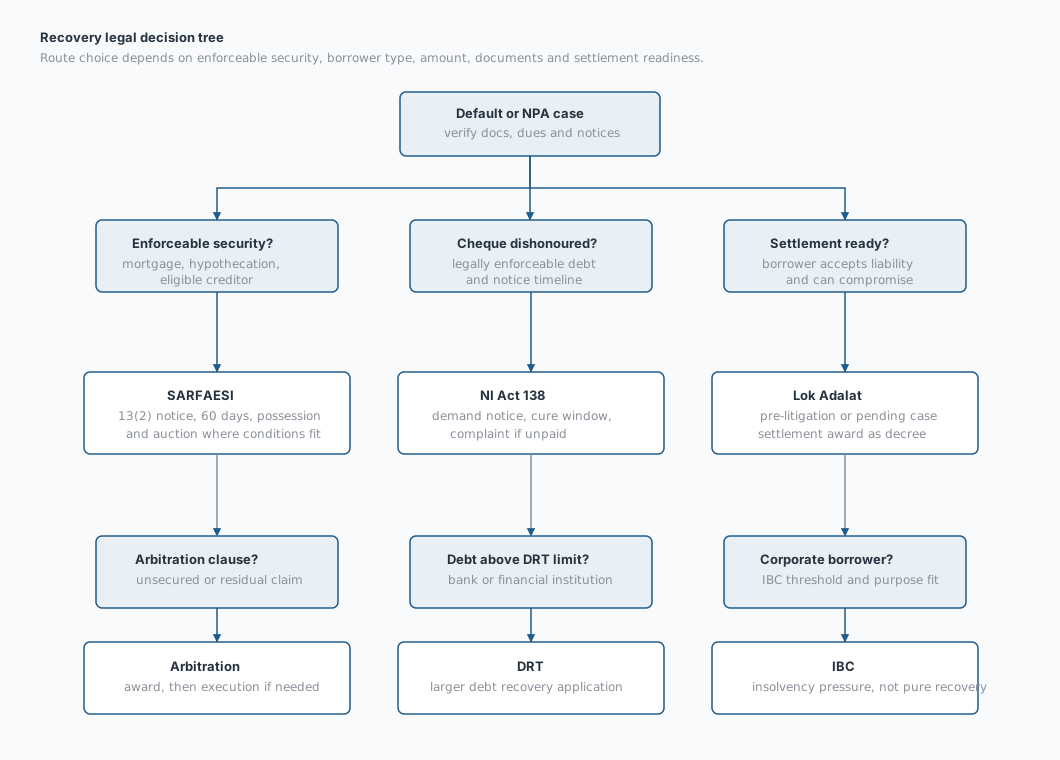
| Tool | Best suited for | Main limitation |
|---|---|---|
| SARFAESI | Secured loans with enforceable security interest | Not for agricultural land; statutory thresholds and process apply. |
| NI Act section 138 | Dishonoured cheques issued for legally enforceable debt | Criminal complaint route; timeline-sensitive; cheque must exist. |
| Arbitration | Loan agreements with arbitration clause, unsecured or secured residual claim | Award still needs execution if borrower does not pay. |
| DRT | Bank/FI debt recovery above threshold | Tribunal capacity and documentation discipline matter. |
| Lok Adalat | Settlement-ready accounts | Works only when compromise is possible. |
| IBC | Corporate borrower/guarantor default where insolvency pressure is appropriate | Not a pure recovery forum; threshold and NCLT process apply. |
SARFAESI
Section titled “SARFAESI”The Securitisation and Reconstruction of Financial Assets and Enforcement of Security Interest Act, 2002 (SARFAESI) lets a secured creditor enforce security without first filing a civil suit. The core step is section 13. After the borrower account is classified as NPA, the secured creditor issues a demand notice under section 13(2), giving 60 days to discharge liabilities. The notice should state the amount payable and secured assets intended to be enforced. If the borrower makes objections/representation, the secured creditor must communicate reasons for non-acceptance within 15 days under section 13(3A) (SARFAESI Act, 2002, India Code).
If dues are not discharged within 60 days, section 13(4) measures include taking possession of secured assets, taking over management, appointing a manager or requiring third parties who owe money to the borrower to pay the secured creditor. For immovable property, the Security Interest (Enforcement) Rules, 2002 require possession notice, publication in two newspapers including one vernacular paper, valuation by approved valuer, reserve price, borrower sale notice and public notice for auction/tender. Rule 8 and Rule 9 provide the 30-day sale notice framework for immovable secured assets and payment mechanics for auction purchaser (Security Interest (Enforcement) Rules, 2002, Rule 8 and Rule 9).
Borrower remedy is through the Debts Recovery Tribunal (DRT). A person aggrieved by section 13(4) measures may apply to DRT within 45 days (SARFAESI section 17, India Code). DRT is expected to dispose such applications quickly, with a statutory 60-day target and outer pendency framework up to four months in section 17(5). Appeal to DRAT is within 30 days, with borrower pre-deposit of 50% of debt claimed/determined, reducible to not less than 25% (SARFAESI section 18, India Code).
Thresholds matter. Section 31 excludes security interests securing repayment not exceeding ₹1 lakh, agricultural land, and cases where amount due is less than 20% of principal and interest (SARFAESI section 31, India Code). For NBFCs, the Central Government specified NBFCs with assets of ₹100 crore and above as financial institutions for SARFAESI; the secured-debt threshold was ₹50 lakh under S.O. 856(E) dated February 24, 2020 and was reduced to ₹20 lakh by S.O. 652(E) dated February 12, 2021 (S.O. 652(E), Ministry of Finance notification mirror). Where HFC/NBFC applicability is disputed, use current counsel opinion because case law has continued to test edge cases.
NI Act Section 138
Section titled “NI Act Section 138”Section 138 of the Negotiable Instruments Act, 1881 is useful when the borrower or guarantor issued a cheque towards a legally enforceable debt and it is dishonoured for insufficiency of funds or exceeding arrangement. It is not a substitute for weak documentation; the cheque and debt trail must be clean.
The statutory timeline is strict. The cheque must be presented within its validity period. On receiving information of dishonour from the bank, the payee/holder must send written demand notice within 30 days. The drawer has 15 days from receipt of notice to pay. If not paid, the complaint under section 142 must be filed within one month from the date cause of action arises, with court power to condone delay for sufficient cause (NI Act section 138 and section 142).
Sentence can extend to two years, fine can extend to twice the cheque amount, or both. Courts may direct interim compensation up to 20% of cheque amount, payable within 60 days with possible extension up to 30 days (NI Act section 143A). In collections practice, section 138 is strongest where the borrower still operates and wants to avoid criminal process; it is weaker against shell entities, closed proprietorships or cheques with signature/date/authority disputes.
Arbitration
Section titled “Arbitration”Most NBFC loan agreements contain arbitration clauses. Arbitration is common for unsecured business loans, equipment loans and residual shortfall after asset sale. Proceedings commence when the respondent receives a request to refer the dispute to arbitration unless parties agreed otherwise (Arbitration and Conciliation Act, 1996, section 21). Domestic awards are to be made within 12 months from completion of pleadings, extendable by party consent for six months; fast-track arbitration can produce an award within six months where agreed (section 29A and section 29B).
An award may still be challenged under section 34 within three months, with a further 30-day condonable window but not thereafter (section 34). For collections, arbitration gives a money award; execution still requires attachable assets or pressure.
The Recovery of Debts and Bankruptcy Act, 1993 gives DRT jurisdiction for applications by banks and financial institutions. The Act itself states it does not apply where debt due is below ₹10 lakh or such notified higher amount; the Central Government notification S.O. 4312(E) dated September 6, 2018 increased DRT pecuniary jurisdiction from ₹10 lakh to ₹20 lakh (RDB Act section 1, India Code). Section 19 governs original applications; defendants ordinarily get 30 days for written statement, extendable by up to 15 days in exceptional cases (RDB Act section 19 extract, India Code). DRAT appeal requires 50% pre-deposit, reducible to not less than 25% (RDB Act section 21).
DRT is useful for larger unsecured residual claims, guarantor enforcement and cases where SARFAESI alone will not recover full dues.
Lok Adalat
Section titled “Lok Adalat”Lok Adalat is a settlement forum, not adjudication of disputed liability. Under the Legal Services Authorities Act, 1987, Lok Adalats can determine compromise/settlement in pending cases or pre-litigation matters, except non-compoundable offences. An award is deemed a civil-court decree, is final and binding, and no appeal lies (Legal Services Authorities Act, 1987, sections 19-21). It works well for small-ticket SME and micro-business loans where the borrower accepts liability and needs documented instalment settlement.
The Insolvency and Bankruptcy Code, 2016 (IBC) is relevant when the borrower is a company or limited liability partnership, not an individual proprietor. Financial creditors file under section 7, operational creditors under section 9, and corporate applicants under section 10. The default threshold for Part II corporate insolvency was raised to ₹1 crore by MCA notification S.O. 1205(E) dated March 24, 2020 (IBBI notification listing; IBC section 4 text).
Once admitted, Corporate Insolvency Resolution Process (CIRP) brings moratorium under section 14, including a bar on enforcement of security interest such as SARFAESI actions against the corporate debtor’s property. CIRP is to be completed within 180 days, extendable, with a statutory outer limit of 330 days including litigation time under section 12 (IBC, India Code). For SME lenders, IBC is often leverage against solvent-but-defaulting companies, but it can also destroy bilateral recovery control once the case is admitted.
Sources
Section titled “Sources”- SARFAESI Act, 2002, India Code
- SARFAESI section 17, India Code
- SARFAESI section 18, India Code
- SARFAESI section 31, India Code
- Security Interest (Enforcement) Rules, 2002 - Rule 8 and Rule 9
- Negotiable Instruments Act section 138, India Code
- Arbitration and Conciliation Act, 1996, India Code
- Recovery of Debts and Bankruptcy Act, 1993, India Code
- Legal Services Authorities Act, 1987, India Code
- Insolvency and Bankruptcy Code, 2016, India Code