Part 06 — Collections & Recovery
Collections Operations
Collections is an operating system, not a late-stage legal function. In SME lending it starts before delinquency, because the first missed instalment is often caused by settlement timing, GST refund delay, a delayed receivable, a changed bank account or a bounced mandate rather than an intent to default. The goal is to recover cash while preserving viable businesses, maintaining regulatory conduct standards and producing clean evidence for escalation.
Operating Model
Section titled “Operating Model”A typical mid-sized non-banking financial company (NBFC) or bank SME vertical splits collections into:
| Layer | Owner | Account range |
|---|---|---|
| Pre-due and early bucket | In-house telecalling or contact-centre partner | X bucket to 30 DPD. |
| Hard bucket | Field collections and senior telecalling | 31-90 DPD, higher ticket 1-30 DPD. |
| Recovery | Legal, repossession, settlement, enforcement team | 90+ DPD, skip, fraud, secured enforcement. |
| Portfolio control | Risk/analytics/finance | Roll rates, provisioning, write-off, policy feedback. |
Large banks often keep strategy, allocations, high-value SME relationships and legal decisions in-house while outsourcing dialer capacity or field follow-up. Fintech NBFCs use collections platforms such as Credgenics, Spocto, LeadSquared, Exotel, Ozonetel, Ameyo or internal loan management system (LMS) modules to run campaigns, payment links, agent apps and call recordings. The vendor is only tooling or manpower; the regulated entity remains accountable for outsourced conduct. RBI’s Digital Lending Directions, May 8, 2025 say an RE remains fully responsible for acts and omissions of its lending service providers (LSPs), including recovery activity.
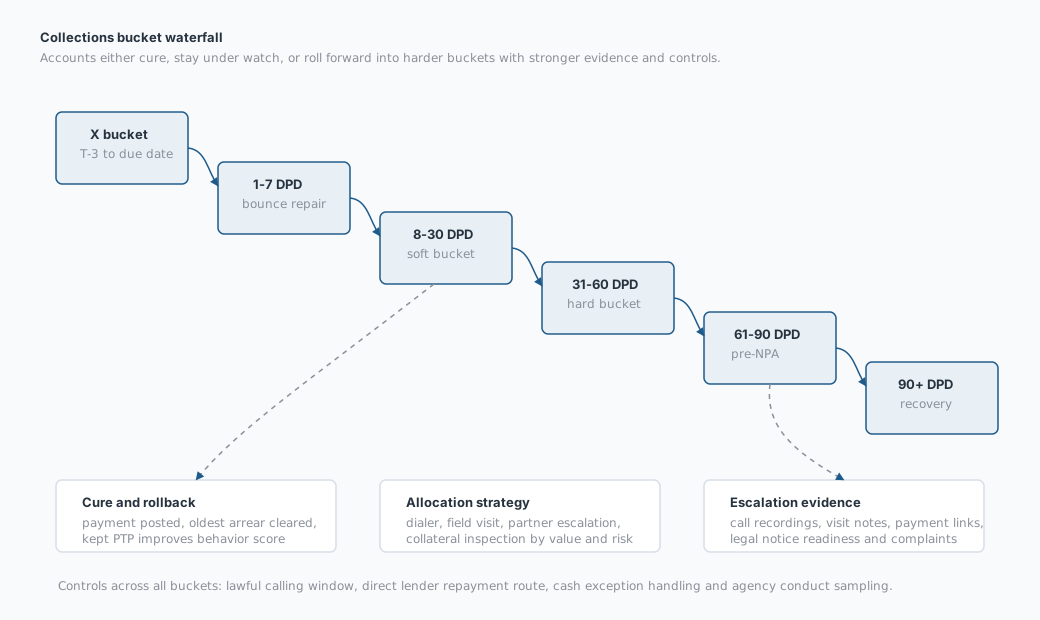
Allocation Logic
Section titled “Allocation Logic”Accounts are allocated by risk, value and recoverability. A ₹7 lakh unsecured working-capital loan at 3 DPD with a clean prior record should not receive the same field intensity as a ₹1.8 crore LAP account at 62 DPD with unpaid property tax and no business activity at the registered address.
Useful segmentation:
| Signal | Strategy |
|---|---|
| First bounce, historically clean | Soft reminder, payment link, same-day re-presentation if mandate permits. |
| Chronic 1-15 DPD | Calendar discipline, settlement-account monitoring, autopay repair. |
| 30+ DPD unsecured | Owner contact, business visit, cash-flow diagnosis, guarantor reminder. |
| 60+ DPD secured | Collateral inspection, legal notice readiness, updated valuation if large exposure. |
| Skip or refusal | Field trace, negative-area controls, legal hold, fraud review. |
| Partner-sourced loan | Partner escalation with clear conduct boundaries and RE-owned repayment route. |
For small-ticket merchant cash advances, a daily or weekly settlement sweep may cure arrears without a physical visit. For machinery finance, the first field visit should verify machine location, condition, hypothecation plate and whether the machine is still in productive use. For LAP, the visit checks possession, occupancy, encumbrance signs, local saleability and whether municipal/property-tax issues could block recovery.
Dialer And Contact Strategy
Section titled “Dialer And Contact Strategy”The best dialer strategy is not “call more”. It is call the right party, at a lawful time, with a clear cure amount and a next action. RBI’s recovery-agent circular prohibits persistent calling and calls before 8:00 a.m. or after 7:00 p.m. (RBI Outsourcing of Financial Services - Responsibilities of REs employing Recovery Agents, August 12, 2022). That means campaign design needs controls: time-window locks, DND/consent policy, language preference, call-attempt caps, supervisor barging, call recording and complaint suppression.
Common campaigns:
| Campaign | Timing | Message |
|---|---|---|
| Pre-due | T-3 to T-1 | EMI date, amount, bank balance reminder. |
| Bounce day | Day 0/1 | Mandate failed, pay link, re-presentation plan. |
| Broken PTP | Same day | PTP missed, new payment time, escalation warning. |
| 30+ | Weekly cadence | Consequence of continued default, credit bureau, field visit. |
| 60+ | Manager-led | Legal escalation, settlement/restructuring assessment, collateral review. |
Payment links should credit the lender’s account directly. For digital lending, RBI requires servicing and repayment directly into the RE’s bank account and prohibits pass-through/pool accounts of LSPs, except cash recovery in delinquent cases where necessary; any cash recovery must be reflected in the borrower’s account the same day (RBI Digital Lending Directions, para 9, May 8, 2025).
PTP Discipline
Section titled “PTP Discipline”A Promise to Pay (PTP) is useful only if it is specific. “Customer said he will pay soon” is not a PTP. A valid PTP record should include amount, date, mode, source of funds, party making commitment, contact number, agent ID and next action if broken.
PTP ageing matters:
| PTP status | Interpretation |
|---|---|
| Open future PTP | Do not over-call unless high risk or prior broken PTP. |
| Kept PTP | Weight positively in behaviour score. |
| Part-kept | Update cure amount; do not treat as regularised unless arrears clear. |
| Broken PTP once | Escalate cadence; ask for reason. |
| Broken PTP repeatedly | Field/legal/settlement screen depending on ticket and security. |
For SME borrowers, source-of-funds notes are operationally valuable: “₹8 lakh receivable from Tata Steel vendor payment due Friday” is better than “will arrange funds”. The next field visit can ask for invoice, e-way bill or bank statement evidence. See underwriting data for the same data sources in the underwriting stage.
Agency Empanelment
Section titled “Agency Empanelment”Empanelment is a control process. The lender should approve agencies through operations, compliance and business, not only procurement. Minimum checks include certificate of incorporation or proprietorship documents, GST and PAN, office verification, principal background, litigation/blacklist search, police verification process for field executives, information-security controls, call-recording capability, language coverage, training completion and references from banks/NBFCs.
RBI’s bank recovery-agent instructions require antecedent verification, borrower intimation of agency details when cases are forwarded, agents carrying notice/authorisation and ID card, call recording precautions, grievance mechanism and training; the old bank master circular also warns that stiff targets or high incentives can induce questionable behaviour (RBI Master Circular on Loans and Advances - Statutory and Other Restrictions, July 1, 2015). For NBFCs, the NBFC Fair Practices Code directions require proper training, a Board-approved code of conduct for DSA/DMA/recovery agents, confidentiality and no intimidation or harassment.
Good agency contracts contain: approved activities, geography, product scope, data fields shared, data-retention period, audit rights, prohibition on sub-contracting without approval, customer-contact rules, cash-handling rules, complaint penalties, termination rights and indemnity. The agency should not be allowed to negotiate waiver, repossess collateral, file police complaints or threaten legal action unless the lender has explicitly authorised the step and provided scripts/templates.
Incentives
Section titled “Incentives”Collections incentives should pay for recoveries, cures and sustained normalisation, not just gross cash. A workable structure:
| Bucket | Payout basis | Guardrail |
|---|---|---|
| 1-30 | Kept PTP/cure rate, bounce recovery | No payout on payment reversed within 7 days. |
| 31-60 | Cash collected plus rollback to lower bucket | Higher weight for full arrear cure. |
| 61-90 | NPA prevention and documented field resolution | Manager approval for waiver-linked payouts. |
| 90+ | Net recovery after legal/repossession cost | Exclude unlawful or complaint-tainted recoveries. |
High-pressure incentives are a conduct risk. Recovery agent scorecards should include complaint rate, call-quality score, documentation quality, cash reconciliation TAT, percentage of accounts with valid disposition and roll-forward prevention. A low complaint rate is not enough if the agent is avoiding call recording or using personal phones.
Cash And Field Controls
Section titled “Cash And Field Controls”Cash should be exceptional, especially for digital loans. When used, the agent app should generate a receipt immediately, capture denomination details if material, geo-tag the collection, sync the receipt to LMS and require same-day deposit. For field visits, the agent should see only minimum required customer data. A visit disposition should capture business open/closed, borrower met/not met, collateral seen, employee count, stock level, neighbouring reference and photographs only where permitted by policy and privacy law.
The operations dashboard should track collection efficiency, current bucket resolution, roll-forward, bounce rate, kept PTP, cost per rupee collected, agency productivity, complaint rate and vintage loss emergence. Collections is also a feedback loop: recurring bounces from one sourcing partner, geography, bank mandate type or product variant should trigger pre-screening and underwriting decisioning policy changes.
Sources
Section titled “Sources”- RBI Outsourcing of Financial Services - Responsibilities of regulated entities employing Recovery Agents, August 12, 2022
- RBI Reserve Bank of India (Digital Lending) Directions, 2025, May 8, 2025
- RBI Master Circular - Loans and Advances - Statutory and Other Restrictions, July 1, 2015
- RBI NBFC Fair Practices Code in NBFC Directions, 2016 updated version