Part 05 — The Lending Lifecycle
Overview
Purpose
Section titled “Purpose”The SME lending lifecycle is the operating spine from first lead to live account monitoring. A real Indian lender does not run it as a single “apply, approve, disburse” screen. It is a sequence of sales, operations, credit, risk, legal, finance and compliance hand-offs, each leaving an auditable trail because banks and non-banking financial companies (NBFCs) remain responsible for outsourced work. RBI’s Reserve Bank of India (Digital Lending) Directions, 2025, dated 8 May 2025, make that point explicit for lending service providers (LSPs): outsourcing does not dilute the regulated entity’s responsibility, and fund flow must normally be between borrower and lender accounts, not through partner pools (RBI Digital Lending Directions, 2025).
For the rest of Part 5, read this page as the map. Each stage page expands one row in the operating model: sourcing, pre-screening, KYC onboarding, documents, underwriting data, decisioning, due diligence, collateral/legal, sanction, documentation/security, disbursement, servicing, monitoring and special workflows.
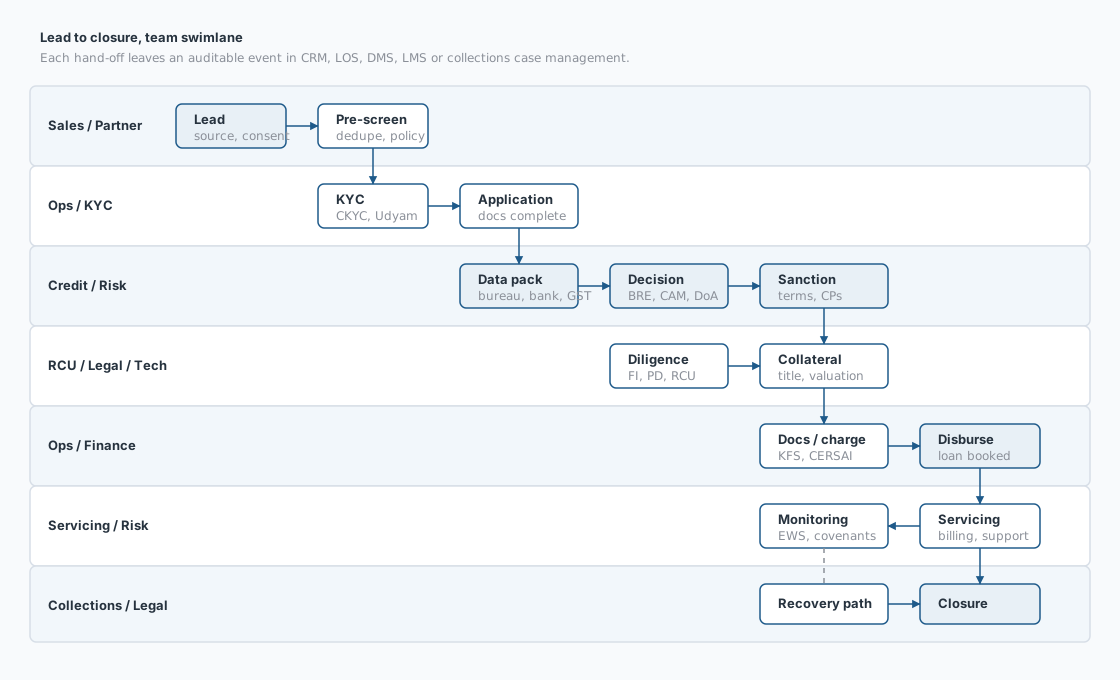
Actors
Section titled “Actors”The principal actors are the relationship manager (RM), direct selling agent (DSA) or connector, branch sales officer, tele-sales team, customer onboarding operations, KYC/anti-money laundering (AML) team, bureau operations, credit analyst, credit manager, risk control unit (RCU), field investigation (FI) agency, personal discussion (PD) officer, legal and technical vendors, operations maker-checker, treasury/finance, collections setup team, compliance, and customer service. In co-lending, add originating regulated entity, partner regulated entity, escrow bank, reconciliation team and partner operations.
Inputs & documents
Section titled “Inputs & documents”The lifecycle begins with a lead record and ends with a loan account, repayment schedule, security package, bureau reporting record and monitoring obligations. Inputs include consent, permanent account number (PAN), goods and services tax identification number (GSTIN), Udyam Registration Number (URN), constitution documents, bank statements, income tax returns (ITRs), financial statements, bureau reports, collateral papers, sanction terms, Key Facts Statement (KFS), loan agreement, guarantees, mandates and insurance. KFS is mandatory for new retail and MSME term loans sanctioned on or after 1 October 2024, with annual percentage rate (APR), amortisation schedule and all charges disclosed upfront (RBI KFS circular, 15 April 2024).
Step-by-step workflow
Section titled “Step-by-step workflow”| Stage | Primary owner | Main system | Practical output |
|---|---|---|---|
| Lead capture | Sales/DSA/partner | Customer relationship management (CRM), partner portal | Lead with source, consent, product intent and location |
| Pre-screen | Sales ops/credit policy | Loan origination system (LOS), dedupe, bureau gateway | Eligible, reject, refer or document-pending status |
| KYC onboarding | Ops/KYC | KYC module, CKYCR, DigiLocker, video-CIP | Applicant and beneficial-owner identities verified |
| Application and documents | Sales ops | LOS/document management system (DMS) | Application form and document checklist completed |
| Underwriting data | Credit analyst | Bureau, bank statement analyzer, GST/ITR tools | Normalised cash-flow and obligation pack |
| Decisioning | Credit | Business rules engine (BRE), scorecard, credit workflow | Approval, rejection, conditional approval or deviation |
| Due diligence | RCU/FI/credit | Vendor workflow, case management | FI, PD, RCU and reference findings |
| Collateral valuation/legal | Legal/technical | Collateral system, legal vendor portal | Title search, valuation, loan-to-value (LTV), insurance needs |
| Sanction | Credit authority | LOS/credit committee module | Sanction letter, conditions precedent and covenants |
| Documentation/security | Operations/legal | DMS, e-sign/e-stamp, CERSAI, ROC | Executed agreements, guarantees and registered charge |
| Disbursement | Operations/finance | Loan management system (LMS), payment rails | Loan account, schedule, mandate and payout |
| Servicing | Customer ops/LMS | LMS, customer portal | Statements, closures, top-ups, service requests |
| Monitoring/EWS | Risk/collections | EWS, bureau refresh, covenant tracker | SMA/NPA watch, covenant exceptions, renewal queue |
Exceptions & edge cases
Section titled “Exceptions & edge cases”Common exceptions are duplicate borrower exposure across branches, blacklisted areas, politically exposed persons (PEPs), negative industry tags such as banned chemicals or speculative trading, proprietors using personal accounts for business, GST turnover much lower than bank credits, low bureau score but strong collateral, director resignation after sanction, property title defects, unregistered partnership deeds, unpaid statutory dues, multiple GSTINs under one PAN, and borrower refusal to accept APR after KFS disclosure. A good LOS should stop the file only where the exception is policy-critical; otherwise it should route a deviation with authority, justification and expiry.
Systems touched
Section titled “Systems touched”The minimum stack is CRM, DSA portal, LOS, KYC/AML screening, CKYCR integration, DigiLocker, bureau gateway, BRE, DMS, bank-statement analyzer, GST and ITR data connectors, collateral system, vendor case workflow, LMS, payment/mandate gateway, general ledger, customer communication service, regulatory reporting and collections case management. Named Indian market tools often seen in the stack include Lentra or Newgen for LOS/workflow, Perfios or FinBox for bank statements, Probe42 or Tofler for company intelligence, Karza/Signzy/IDfy/OnGrid for KYC and fraud checks, Yubi for co-lending and LSP integrations, and Pennant or Nucleus FinnOne for LMS.
TATs/SLAs
Section titled “TATs/SLAs”Typical industry turnaround time (TAT) depends on ticket and security. A pre-approved ₹5 lakh merchant loan can be sanctioned in minutes to hours if bureau, bank and GST data are straight-through. A ₹25-75 lakh unsecured business loan usually takes 1-3 working days to sanction and another 1-2 days to disburse. A ₹1-5 crore loan against property (LAP) or working-capital limit commonly takes 7-21 days because title, valuation, FI and documentation drive the clock. Digital journeys compress customer touchpoints, but RBI still requires creditworthiness assessment before digital loan extension (RBI Digital Lending Directions, 2025).
Stage metrics
Section titled “Stage metrics”Track lead-to-login, login-to-sanction, sanction-to-disbursement, straight-through processing (STP) rate, document pendency age, bureau-hit rate, dedupe-match rate, deviation rate, approval rate, disbursal pull-through, first EMI bounce, early delinquency by vintage, RCU-negative rate, FI-negative rate, legal-title rejection rate, and partner-wise yield/credit-cost. For MSME portfolios, combine individual and enterprise borrowing views because SIDBI’s July 2026 MSME Pulse notes that individuals accounted for 28% of combined commercial balance share as of March 2026 (SIDBI MSME Pulse July 2026).
Co-lending/partner-origination variant
Section titled “Co-lending/partner-origination variant”In co-lending, the lifecycle splits between the originating entity and partner entity. The 2025 co-lending directions apply from 1 January 2026 unless an entity adopts them earlier; each co-lender must retain at least 10% of individual loans, borrower disclosures must identify role segregation and customer interface, and books must reflect each share within 15 calendar days of disbursement (RBI Co-Lending Arrangements Directions, 2025). This means the LOS must store lender-share, KFS disclosures, escrow allocation, partner decision status, partner rejection reason and near-real-time asset classification sharing.