Part 05 — The Lending Lifecycle
Underwriting Data
Purpose
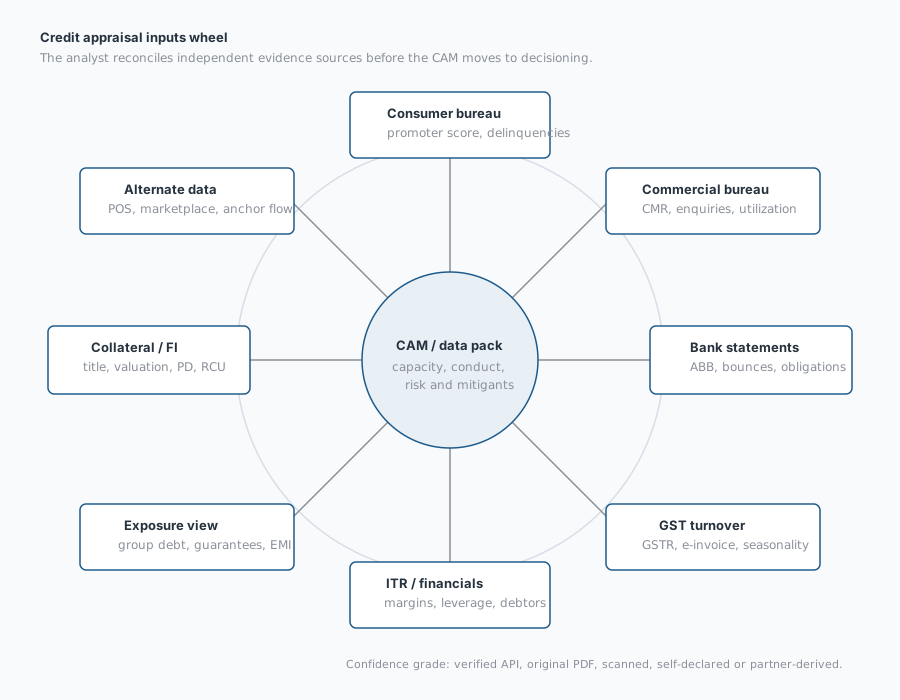
Section titled “Purpose”Underwriting data is the evidence layer behind a credit decision. The goal is to convert raw documents and API pulls into a coherent view of repayment ability, leverage, conduct, fraud risk and business stability. In Indian SME lending, this means joining at least five views: promoter consumer bureau, entity commercial bureau, bank statement behaviour, GST/turnover data and income/financial statements. The next page, underwriting decisioning, turns these into eligibility, pricing, deviations and a credit note.
For the integrated source-to-CMA-to-CAM package, see The Credit Appraisal Package.
Actors
Section titled “Actors”Actors are credit analyst, credit manager, bureau operations, bank statement operations, GST/ITR data operations, risk analytics, RCU, sales for clarifications, borrower/accountant, and partner data team. For larger loans, chartered accountant-reviewed financials, stock statements and debtor/creditor schedules may enter the pack.
Inputs & documents
Section titled “Inputs & documents”Inputs are consumer bureau report for proprietor/promoters/guarantors, commercial bureau report for entity, CIBIL MSME Rank or CreditVision CIBIL Commercial Rank where available, bank statements for 6-12 months, GST returns (GSTR-1, GSTR-3B, e-invoice/e-way bill where available), ITRs, audited or provisional financial statements, current obligations, existing sanction letters, loan repayment track, utility/rent proof and alternate data from point-of-sale, marketplace, payment gateway or anchor systems.
TransUnion CIBIL describes CreditVision CIBIL Commercial Rank as a ten-band rank from CMR-1 to CMR-10, with CMR-1 reflecting the strongest profile and CMR-10 the weakest (TransUnion CIBIL CV CMR). Its commercial risk assessment page says the Commercial Credit Information Report includes recent and 36-month history, enquiry details, delinquency, derogatory data and Commercial CreditVision indicators such as vintage, missed payment behaviour, debt build-up, utilisation and delinquency trends (TransUnion CIBIL commercial risk assessment).
Step-by-step workflow
Section titled “Step-by-step workflow”- Map borrowers and obligors: entity, proprietor, directors, partners, guarantors, co-applicants and related entities.
- Pull bureau with valid consent. Interpret score/rank, not just pass/fail. Read enquiries, write-offs, settlements, suit-filed/wilful-default flags, secured/unsecured mix, utilisation and recent delinquency.
- Parse bank statements. Compute monthly credits, average bank balance (ABB), inward return/bounce counts, outward cheque/NACH bounces, EMI obligations, cash deposit share, top counterparties, circular transactions, salary/rent/tax payments and month-end balance dressing.
- Reconcile turnover. Compare GST taxable turnover, bank credits and ITR/financial statement sales. Differences need explanations: cash sales, non-GST exempt sales, multiple bank accounts, related-party transfers or inflated deposits.
- Read financials. Extract revenue, gross margin, EBITDA, profit after tax, capital, unsecured loans, related-party balances, debtors, creditors, inventory, debt, interest and depreciation.
- Add alternate data where policy permits: point-of-sale settlements from Razorpay/Pine Labs, marketplace order flow, UPI/QR collections, anchor purchase history, TReDS invoice performance or SaaS subscription collections.
- Produce a data summary with confidence grade: verified API, original PDF, scanned copy, self-declared or third-party statement.
Exceptions & edge cases
Section titled “Exceptions & edge cases”Banking is often more truthful than unaudited financials, but it has traps. A borrower may rotate funds between group accounts to inflate credits. Cash deposits may be genuine retail sales or undisclosed borrowings. GST may understate turnover for exempt goods or overstate sustainable sales because of one-off bulk orders. ITR profit may be low because of tax planning, while cash flow is adequate; the reverse also happens when unpaid debtors inflate sales.
Commercial bureau reading needs SME nuance. A CMR 6 borrower with clean recent repayment and secured working capital may be acceptable with collateral or lower ticket. A CMR 2 borrower with sudden utilisation spike, multiple enquiries and new unsecured loans may require caution. Micro proprietors may have no commercial bureau but rich consumer bureau and bank data. Treat “no hit” as unknown risk, not good risk.
Systems touched
Section titled “Systems touched”Bureau gateway, LOS, DMS, bank statement analyzer, AA consent manager, GST connector, income-tax/financial statement extraction, fraud analytics, entity-resolution service, data lake, BRE and credit memo generator. Regulated entities and credit information companies are governed by the Master Direction - Reserve Bank of India (Credit Information Reporting) Directions, 2025, dated 6 January 2025, which consolidates credit information reporting requirements under the Credit Information Companies (Regulation) Act, 2005; the official RBI old-site link was intermittently unavailable during verification, but the RBI circular number is RBI/DoR/2024-25/125, DoR.FIN.REC.No.55/20.16.056/2024-25 (RBI link; RBI text mirror used for verification).
TATs/SLAs
Section titled “TATs/SLAs”API-backed data pulls should finish in minutes. Manual bank statement rectification can take 2-6 working hours. GST/ITR reconciliation for small tickets should be same day; full financial spreading for ₹1 crore-plus working capital or LAP files often takes 1-2 working days. If statements are password-protected, scanned or missing pages, the case should not move to decisioning until the data confidence flag is resolved.
Stage metrics
Section titled “Stage metrics”Track bureau hit rate, commercial bureau availability, CMR distribution, AA success rate, bank statement parse success, GST pull success, turnover reconciliation variance, bounce count distribution, EMI-detection accuracy, data-confidence grade, analyst rework rate and later early delinquency by data pattern. Strong credit teams monitor which data markers actually predict first 6-month default.
Co-lending/partner-origination variant
Section titled “Co-lending/partner-origination variant”Partner data may arrive as derived variables rather than raw documents: GMV, settlement credits, order cancellations, seller ratings, chargebacks or anchor payment days. The regulated entity should store enough raw or auditable evidence to justify creditworthiness. RBI’s digital lending directions require necessary borrower economic-profile information to be obtained and retained for audit before extension of digital loans (RBI Digital Lending Directions, 2025). Co-lenders must also share critical information on timelines agreed in the co-lending agreement.
Sources
Section titled “Sources”- TransUnion CIBIL, CreditVision CIBIL Commercial Rank
- TransUnion CIBIL API Marketplace, Commercial Credit Risk Assessment
- RBI, Master Direction - Reserve Bank of India (Credit Information Reporting) Directions, 2025, official link
- RBI text mirror used only because the official old-site page was intermittently unavailable
- RBI, Reserve Bank of India (Digital Lending) Directions, 2025, 8 May 2025